
The Nursing Posture Nobody Talks About: Protecting Mom's Neck, Back, and Wrists
Why Nursing Posture Is Quietly Hurting More Moms Than Anyone Realizes
The nursing posture nobody talks about: protecting mom's neck, back, and wrists is the slow, cumulative forward curl that happens dozens of times a day during feeding — and it's one of the most overlooked causes of postpartum pain.
Here's a quick summary of what you need to know:
- The problem: Repeated forward-leaning, head-down nursing positions strain your neck, round your shoulders, and load your wrists — often for hours every day.
- Why it happens: Your body is compensating without enough support, not because you're doing anything wrong.
- The most affected areas: Neck, upper back, shoulders, lower back, and wrists.
- What helps most: Bringing baby up to you with pillows, sitting with a neutral spine, and building in gentle movement between feeds.
- When to get help: If pain disrupts sleep, causes tingling or numbness, or doesn't improve with positioning changes, see a professional.
Up to 72% of breastfeeding mothers experience significant musculoskeletal pain. Yet most postpartum care conversations focus on the baby's latch — not on your body.
The reality is that new mothers spend several hours a day feeding, often curled into what one physical therapist describes as a "comma" shape — head dropped, shoulders rounded, wrists bent. Over days and weeks, those small posture compromises add up into real pain.
You don't have to push through it. Understanding what's happening in your body is the first step toward feeling better.
I'm Dr. Leah Bagg, a chiropractor with specialized training in women's health, prenatal care, and postpartum recovery — and supporting mothers through exactly this kind of accumulated strain is at the heart of what I do at Magnolia Chiropractic. In the sections below, I'll walk you through why nursing posture causes so much pain, what the research says about protecting your neck, back, and wrists, and what gentle, practical steps can help.
The Nursing Posture Nobody Talks About: Protecting Mom's Neck, Back, and Wrists
When we think of nursing, we often picture a serene, peaceful moment of bonding. What we rarely discuss is the physical reality: sitting in a chair, sleep-deprived, at 3:00 a.m., trying to hold a growing baby while keeping them latched.
Postpartum back and neck pain doesn't usually happen because of one sudden movement. Instead, it is the result of dozens of tiny postural compromises made throughout the day. When you lean forward to help your baby latch, or curl your body around theirs to keep them secure, you create a sustained "comma" shape. Over time, these micro-movements and static holds build up massive cumulative strain.
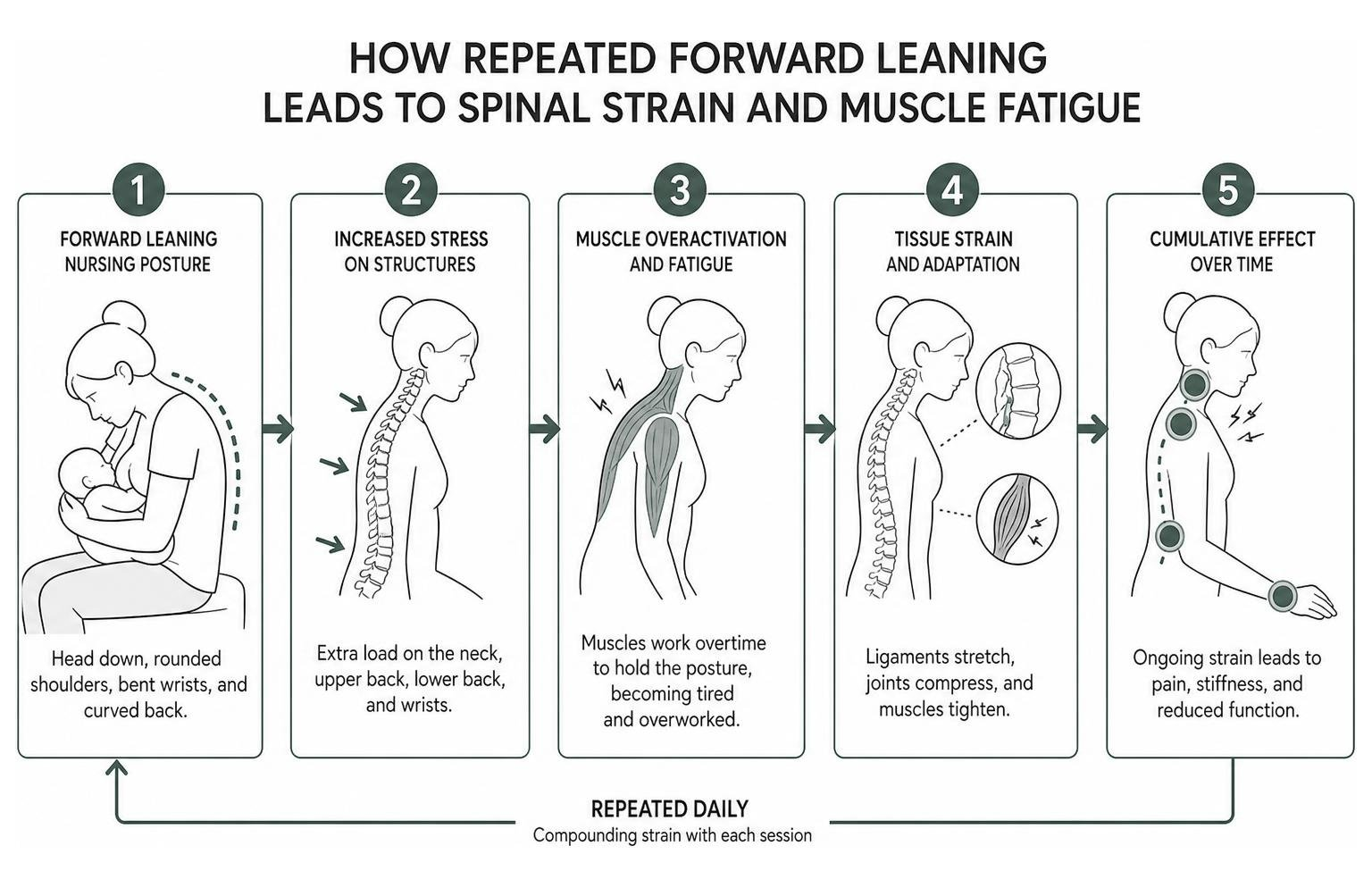
According to physical therapy insights on Postpartum Back & Neck Pain: The Nursing Posture Fix | Wander & Roam, the hours spent in these static, forward-curled positions fatigue the upper back muscles while overstretching the ligaments of the spine. When your core and pelvic floor are still recovering from pregnancy and birth, your upper body has to work twice as hard to keep you upright, leading to the aching and burning so many mothers feel between their shoulder blades.
Understanding the Nursing Posture Nobody Talks About: Protecting Mom's Neck, Back, and Wrists
The most common postural pitfall for new mothers is what we call the "hovering" trap. Instead of bringing the baby up to the breast, mothers naturally tend to lean their entire torso forward, hovering over the baby.
This position causes several joint and muscle issues simultaneously:
- Deep Neck Flexion: Craning your head downward to watch your baby latch or stare at their face puts incredible pressure on the cervical spine. For every inch your head tilts forward, you double the physical load on your neck muscles.
- Rounded Shoulders: Hovering forces your shoulders forward, tightening the chest muscles and overstretching the upper back.
- Wrist and Finger Strain: If your baby is not fully supported by pillows, your hands and wrists must bear their weight. Holding your baby's head in the web space of your hand with a bent wrist puts intense pressure on the delicate tendons of the wrist.
As noted in ergonomics guides from the Oh, my aching… What nursing moms should know about ergonomics and brea – Motherlove Herbal Company, carrying out daily childcare tasks while joints are still healing can easily lead to repetitive strain injuries. When your wrists are bent at extreme angles for 20 to 30 minutes at a time, multiple times a day, you run a high risk of developing tendonitis or nerve compression.
How Upper Cross Syndrome and Ligament Laxity Create Chronic Pain
When the hovering posture becomes your default, it can develop into a clinical postural imbalance known as Upper Cross Syndrome. This syndrome is characterized by a specific pattern of muscle tightness and weakness:
- Tight Muscles: The upper trapezius, levator scapulae (back of the neck), and pectorals (chest).
- Weak Muscles: The deep neck flexors (front of the neck) and the rhomboids and middle trapezius (mid-back).
This imbalance pulls your shoulders forward and pushes your chin out, making it difficult to stand or sit comfortably even when you aren't nursing.
Compounding this muscular imbalance is the hormone relaxin. Relaxin is produced during pregnancy to soften your ligaments and pelvis for birth, and it remains in your body for months postpartum—especially if you are breastfeeding. While relaxin is essential for delivery, it makes your joints temporarily less stable. Without strong ligament support, your muscles have to work harder to maintain your posture, making you much more susceptible to strains, sprains, and joint dysfunction.
Furthermore, these postural changes can restrict your diaphragm, forcing you into shallow upper-chest breathing. This shallow breathing pattern further tightens your neck and shoulder muscles, creating a cycle of tension. If the spinal joints in your neck and upper back become restricted, it can even affect your nervous system, leading to systemic fatigue or tension headaches. You can read more about how these patterns impact your body in our guide on Common Signs Your Nervous System Is Out of Balance.
Practical Ergonomics: Bringing Baby to Breast
To break this cycle of pain, we must change how we set up our feeding environment. The most important rule of nursing ergonomics is simple: bring the baby to your breast, do not bring your breast to the baby.
Creating an ergonomic nursing station helps keep your body in a balanced, supported position. Here is how to set up your space:
- Sit in Pelvic Neutral: Sit all the way back in your chair so your lower back is fully supported. Avoid slumping or perching on the edge of the seat. If your chair is too deep, place a small lumbar roll or rolled-up towel behind your lower back.
- The 90-90-90 Rule: Your hips, knees, and ankles should ideally be bent at 90-degree angles. Keep your feet flat on the floor. If your feet don't reach comfortably, use a low footstool or a firm cushion to bring the floor up to you.
- Support Your Arms and Baby: Use firm nursing pillows or folded bed pillows under your baby to lift them to breast height. Your elbows should rest comfortably on the armrests or pillows at a relaxed angle, allowing your shoulders to drop away from your ears.
By setting up your environment to support your body, you can prevent neck and shoulder tension before it even starts. For more detailed tips on workstation and home ergonomics, check out Nursing Posture Tips To Prevent Neck And Shoulder Pain.
Ergonomic Solutions and Postpartum Recovery for Long-Term Wellness
Postpartum recovery is a holistic process. Your body has gone through massive structural changes over the last nine months, and healing requires looking at how your whole system works together.
For example, your core and pelvic floor muscles were stretched during pregnancy, which reduces their ability to support your spine. When your pelvis and lower back lack stability, your upper back and neck have to compensate, leading to the tension you feel while nursing. Working on your posture is not just about sitting up straight; it is about restoring balance to your entire body. To learn more about this connection, read our article on Pelvic Floor Chiropractic: The Connection Most Moms Don't Know About.
Correcting the Nursing Posture Nobody Talks About: Protecting Mom's Neck, Back, and Wrists
Varying your nursing positions throughout the day is one of the best ways to prevent repetitive strain. Holding the exact same position for every feed overworks the same muscle groups. By rotating through different holds, you give tired muscles a chance to rest and recover.
The Mayo Clinic outlines several foundational Breastfeeding positions that can be adapted for comfort:
- The Cross-Cradle Hold: Excellent for newborns. You support the baby’s head with the hand opposite the breast they are feeding from. Ergonomic tip: Use a pillow under your forearm so your wrist doesn't have to hold the baby’s weight.
- The Football (Clutch) Hold: The baby is tucked under your arm like a football. This is highly recommended for C-section recovery because it keeps the baby's weight off your healing incision. Ergonomic tip: Ensure your elbow is well-supported by a pillow so you don't tense your shoulder.
- The Side-Lying Position: You and your baby lie on your sides facing each other. This position completely removes gravitational load from your spine and wrists, making it a wonderful option for night feeds or when your back needs a complete rest.
- The Laid-Back (Semi-Reclined) Position: You recline comfortably on a bed or sofa, supported by pillows, with your baby lying tummy-to-tummy on your chest. Gravity helps keep the baby in place, allowing your arms, shoulders, and neck to relax completely.
No matter which position you choose, remember to sit back, let your support pillows do the heavy lifting, and occasionally look up and forward to give your neck muscles a break. For more advice on choosing furniture that supports these positions, you can refer to Postpartum Back Pain: How the Right Nursing Chair Can Help – MAMAZING.
Gentle Exercises and Stretches for Postpartum Relief
Incorporating gentle movement into your daily routine can help release muscle tension and rebuild your strength. Always listen to your body and consult your care provider before starting any exercise routine postpartum.
Here are a few simple, highly effective movements to try between feeding sessions:
- Cat-Cow Stretch: On your hands and knees, gently arch your back toward the ceiling (cat), then let your belly sink toward the floor while lifting your chest (cow). This helps restore mobility to your spine.
- Foam Roller Snow Angels: Lie lengthwise on a foam roller supporting your head and tailbone. Keep your knees bent and feet flat. Let your arms rest on the floor, palms up, and slowly slide them overhead like you are making a snow angel. This is an excellent chest opener.
- Open-Book Rotations: Lie on your side with your knees bent. Reach both arms out in front of you. Slowly lift your top arm up and over to the opposite side, opening your chest toward the ceiling while keeping your hips steady.
- Transverse Abdominis (TA) Holds: Gently draw your belly button toward your spine as you exhale, holding for a few seconds while breathing normally. This helps rebuild deep core stability safely.
- Wrist and Finger Stretches: Extend one arm in front of you, palm facing out. Gently pull your fingers back toward your body with your other hand to stretch your forearm and wrist. Repeat with the palm facing down.
For a safe, step-by-step approach to rebuilding your strength after pregnancy, read our guide on How to Rebuild Core Strength Safely After Pregnancy.
When to Seek Professional Support for Persistent Pain
While adjustments to your nursing setup and gentle stretching can provide significant relief, some postpartum pain requires professional care.
You should consider seeking professional support if you experience:
- Pain that does not improve with positioning changes or rest.
- Numbness, tingling, or shooting pain down your arms, hands, or legs.
- Severe headaches, especially at the base of your skull.
- Pain that interferes with your ability to care for your baby or sleep when they sleep.
At Magnolia Chiropractic in Norman, OK, we provide gentle, evidence-based chiropractic care tailored to your body's unique postpartum needs. We understand that your body has been through an incredible transition, and we take the time to listen, explain, and create a supportive path to recovery.
By restoring proper alignment and joint mobility, gentle chiropractic care can help reduce muscle tension, improve nervous system function, and support your body's natural healing process. You can learn more about our approach by exploring our resources on Chiropractic Care Postpartum Recovery and Prenatal Chiropractor Norman OK.
Your physical well-being is a vital part of your family's wellness. Taking care of your neck, back, and wrists isn't selfish—it is what allows you to hold, feed, and care for your little one with comfort and ease. If you are struggling with postpartum pain, we are here to support you every step of the way.
