
7 Ways to Know if Your Nervous System Is Out of Balance
Your Body Keeps the Score: Why Nervous System Balance Matters

The common signs your nervous system is out of balance are more widespread than most people realize — and easier to miss than you'd think.
Here's a quick overview of what to watch for:
- Fatigue that sleep doesn't fix
- Digestive problems like bloating, constipation, or nausea
- Racing heart or irregular heartbeat
- Anxiety, mood swings, or emotional overwhelm
- Trouble sleeping or staying asleep
- Brain fog or difficulty concentrating
- Muscle tension, headaches, or chronic pain
- Heightened sensitivity to noise, light, or temperature
Your nervous system is your body's control center. It manages everything from your heartbeat and digestion to your mood and stress response — mostly without you thinking about it.
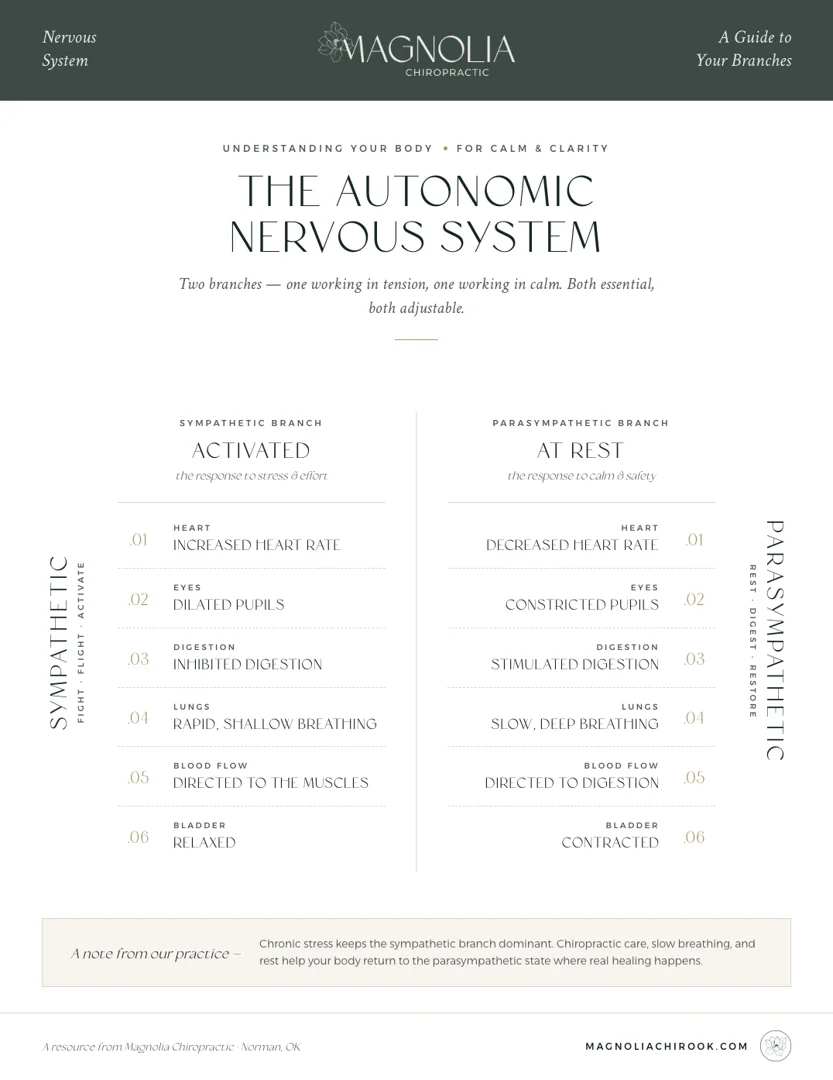
At the heart of this system is the autonomic nervous system (ANS). It has two branches that work together like a seesaw:
- Sympathetic ("fight-or-flight") — activates in response to stress or danger
- Parasympathetic ("rest-and-digest") — helps your body calm down, recover, and heal
When life is going well, these two branches take turns smoothly. But chronic stress, trauma, poor sleep, or injury can tip that seesaw too far in one direction — and keep it there.
In April 2026, more families than ever are navigating relentless schedules, overstimulation, and stress that doesn't switch off. That constant pressure can quietly push your nervous system out of balance, affecting your physical health, emotional well-being, and even your children's development.
I'm Dr. Leah Bagg, a chiropractor with specialized training in pediatric and prenatal care, and I regularly work with mothers, infants, and families in Norman, OK who are experiencing the common signs your nervous system is out of balance — often without realizing that's what's behind how they're feeling. Understanding these signs is the first step toward feeling like yourself again.
Common Signs Your Nervous System Is Out of Balance
When we talk about the nervous system being "out of balance," we are often referring to a state of dysregulation. This means the body has lost its ability to return to a state of calm after a stressor has passed. Instead of the "seesaw" moving back and forth, it gets stuck.
A key player in this balance is the vagus nerve, which acts as the primary "brake" for your stress response. We often measure the health of this system through Heart Rate Variability (HRV). A high HRV generally indicates a resilient, balanced nervous system that can adapt to change, while a low HRV is a hallmark sign of a system that is struggling to keep up.
Comparing Nervous System States
| Feature | Sympathetic Dominance (Stuck On) | Parasympathetic Balance (Regulated) |
|---|---|---|
| Heart Rate | Rapid, pounding, or easily spiked | Steady and adaptable |
| Digestion | Slowed, leading to bloating or reflux | Efficient and comfortable |
| Breathing | Shallow, chest-focused | Deep, diaphragmatic |
| Mood | Anxious, irritable, or "on edge" | Calm, patient, and resilient |
| Sleep | Hard to fall asleep; "wired but tired" | Restorative and consistent |
Physical Manifestations of Dysregulation
The physical common signs your nervous system is out of balance often show up in the systems the autonomic nervous system controls: your gut, your heart, and your energy levels.
Digestive Issues The gut is often called the "second brain" because it contains the highest concentration of nerves outside of the brain itself. When you are in "fight-or-flight" mode, your body deprioritizes digestion to save energy for survival. This can lead to chronic bloating, constipation, or even "functional" disorders that don't have a clear medical cause but feel very real. In fact, in patients with traumatic brain injuries, gastrointestinal issues are the most common physical symptom of dysregulation.
Chronic Fatigue and Sleep Disturbances Have you ever felt exhausted all day, only to feel "wired" the moment your head hits the pillow? This is a classic sign of an overactive nervous system. Research on Chronic Fatigue Syndrome (CFS) shows that individuals often have higher sympathetic activity even during deep sleep. This means even when you are unconscious, your body is still "running from the bear," leading to unrefreshing sleep. Most adults need 8-9 hours of restful sleep, but if your nervous system is imbalanced, quality matters as much as quantity.
Blood Pressure and Heart Rate A study of 126 participants confirmed that sympathetic dominance leads to elevated blood pressure and a racing heart. You might notice your heart pounding for no reason or feeling dizzy when you stand up quickly (orthostatic symptoms). These are symptoms of an overactive nervous system trying to manage blood flow while under perceived threat.
Emotional and Mental Signs of Imbalance
Because the nervous system processes every emotion we feel, an imbalance often manifests as mental health struggles.
Anxiety and Mood Swings When the amygdala (the brain's smoke detector) is hyper-reactive, everything feels like an emergency. You might find yourself snapping at your spouse or feeling a sense of impending doom without a clear cause. This isn't a character flaw; it's a physiological response to a system that feels unsafe.
Brain Fog and Concentration When you are stuck in survival mode, your brain shuts down the prefrontal cortex—the area responsible for logic, memory, and complex decision-making. This results in "brain fog," where you can't remember why you walked into a room or struggle to focus on a simple task.
Sensory Sensitivity About 15-20% of the population are "Highly Sensitive Persons" (HSPs). For HSPs, the common signs your nervous system is out of balance are even more pronounced. You might find that loud noises, bright lights, or even the texture of your clothing feel overwhelming. This heightened sensitivity is a sign that your nervous system is already "full" and cannot process any more incoming data. You can find more about these indicators in this guide to the top 12 signs of a dysregulated nervous system.
Common Signs Your Nervous System Is Out of Balance in Infants and Children

As a pediatric chiropractor in Norman, I often see nervous system imbalance in our smallest patients. Because infants cannot tell us they feel "anxious," their symptoms manifest through their behavior and developmental progress.
Colic and Digestive Distress A baby who cries inconsolably for hours often has a nervous system that is stuck in a sympathetic state. This "tightness" can affect their digestive tract, leading to the discomfort we call colic. Addressing these imbalances early can help a baby return to a "rest-and-digest" state, allowing for better sleep and easier feeding. We often discuss this when parents look for a chiropractor for babies with colic.
Developmental Milestones The nervous system is the blueprint for growth. If a child’s system is dysregulated, it can impact how they reach milestones like crawling and walking. For example, crawling isn't just about movement; it’s a complex neurological process that coordinates the left and right hemispheres of the brain. If the nervous system is under stress, these connections might be delayed or disorganized. Chiropractic care supports this growth by ensuring the "communication lines" (the nerves) are clear and functioning optimally.
Restoring Harmony and Seeking Support
The good news is that the nervous system is incredibly plastic—it can change and heal. Restoring balance isn't about avoiding stress entirely (which is impossible in 2026), but about building "resilience" so your system can bounce back.
One of the most effective ways to do this is by stimulating the vagus nerve and spending time in nature. Research shows that people who spend at least 2 hours per week in greenspaces report significantly better health. Nature provides a "low-arousal" environment that allows the parasympathetic system to naturally take the lead.
Daily Habits for Nervous System Regulation
Restoring balance happens in the small, quiet moments of your day.
- Box Breathing: This is a technique used by elite performers to calm the heart rate. Inhale for 4 seconds, hold for 4, exhale for 4, and hold for 4. This rhythm sends a direct signal to your brain that you are safe.
- Grounding: If you feel an emotional spiral starting, use the 5-4-3-2-1 method. Name 5 things you see, 4 you can touch, 3 you hear, 2 you smell, and 1 you can taste. This pulls your brain out of the "future-tripping" of anxiety and back into the present moment.
- Sleep Hygiene: Since those with an imbalanced system often have higher sympathetic activity at night, creating a "wind-down" routine is vital. Dim the lights, avoid screens, and keep your room cool.
- Nutrition and Adaptogens: Eating magnesium-rich foods and using adaptogens like Ashwagandha can help lower cortisol levels over time. Some studies suggest adaptogens can show results in as little as 21 days.
For more detailed strategies, you might find this list of 7 tips to heal a dysregulated nervous system helpful for your daily routine.
Professional Care for Common Signs Your Nervous System Is Out of Balance
Sometimes, lifestyle changes aren't enough because the "interference" in your nervous system is physical. This is where chiropractic care comes in.
Your spine protects your spinal cord—the "information superhighway" of your body. If there are misalignments (subluxations) in the spine, they can create a constant "noise" or irritation to the nerves. This keeps the body in a state of low-level "fight-or-flight" because the brain is receiving signals of distress from the physical structure.
At Magnolia Chiropractic, we use gentle, evidence-based adjustments to remove this interference. We don't use "one-size-fits-all" cracking; we tailor our care to the individual, whether it’s a pregnant mother or a newborn. By restoring proper alignment, we improve brain-body communication, allowing the nervous system to finally "downshift" into a state of healing.
Parents often see significant changes in their children's behavior and health after starting care, which we detail in our pediatric chiropractic benefits: complete guide.
Finding Long-Term Wellness in Norman
At Magnolia Chiropractic in Norman, OK, we believe that you deserve to feel grounded, vibrant, and present for your family. We know that the common signs your nervous system is out of balance can feel heavy, but you don't have to carry that weight alone.
Our approach is centered on the family. We take the time to listen to your history, perform thorough assessments, and explain the "why" behind your symptoms. Whether you are looking for a prenatal chiropractor in Norman, OK to help your body adapt to pregnancy, or you want to ensure your child has the best neurological start in life, we are here to support you.
Healing the nervous system is a journey, not an overnight fix. But with the right tools, a supportive environment, and gentle professional care, you can move from a state of survival back into a state of thriving. If you're ready to see how a balanced nervous system can change your life, we invite you to reach out and start that conversation with us today.
