
How to Rebuild Core Strength Safely in 7 Easy Steps
How to Rebuild Core Strength Safely After Pregnancy

Rebuilding your core is one of the most important things you can do for your body after having a baby — and it's simpler than most people think.
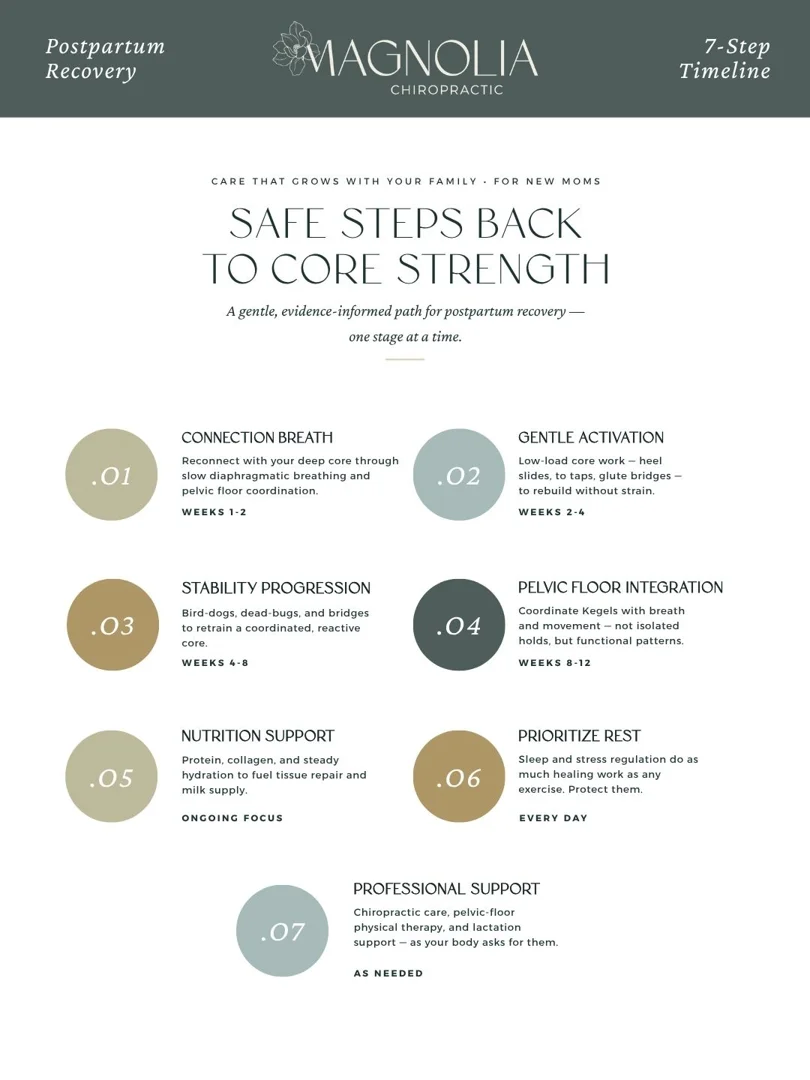
Here are the 7 steps at a glance:
- Master the Connection Breath — diaphragmatic breathing to reconnect your deep core
- Gentle activation — pelvic tilts and heel slides in the first weeks
- Progress to stability exercises — bird-dogs, glute bridges, and modified dead bugs
- Integrate pelvic floor work — coordinate Kegels with core engagement
- Support recovery with nutrition — protein, collagen, and hydration
- Prioritize rest — sleep and stress management are part of healing
- Get professional support — physical therapy or chiropractic care when needed
Your core goes through enormous changes during pregnancy. The muscles stretch, the connective tissue thins, and the pelvic floor bears the weight of a growing baby for months. After delivery — whether vaginal or by C-section — many new mothers are surprised by how disconnected or weak their midsection feels. That's completely normal.
The good news? Your body is built to recover. It just needs the right approach, at the right pace.
Up to 60% of people who give birth experience diastasis recti — a separation of the abdominal muscles along the midline. And more than 30% of births are by Cesarean, which adds a layer of surgical healing on top of the core recovery process. These aren't rare complications. They're common experiences that deserve real, thoughtful guidance.
Rushing back to crunches or intense workouts too soon can actually slow your progress. What works is a calm, step-by-step plan that respects how your body heals.
I'm Dr. Leah Bagg, a chiropractor at Magnolia Chiropractic in Norman, OK, with specialized training in supporting women through pregnancy and postpartum recovery. My experience working with new mothers has given me a deep appreciation for how to rebuild core strength safely after pregnancy in a way that is gentle, evidence-based, and built around real life with a newborn.
To understand how to heal, we first have to look at what the "core" actually is. Many people think of the core as just the "six-pack" muscles (the rectus abdominis), but it is actually a complex system. Think of it as a muscular canister: the diaphragm is the lid, the pelvic floor is the base, and the deep transverse abdominis and back muscles form the walls.
During pregnancy, this canister expands. The rectus abdominis muscles stretch significantly, and the connective tissue between them, known as the linea alba, thins and widens to accommodate your growing baby. This shift changes how your body manages intra-abdominal pressure. According to research on postpartum core changes, this stretching can leave the inner core "deactivated," making everyday movements like lifting your car seat feel much harder.
When the core isn't providing the stability it used to, the lower back often tries to take over the workload. This is why so many new moms in Norman and the OKC metro experience pregnancy-related back pain that persists long after the baby is born. Rebuilding strength isn't just about aesthetics; it's about restoring the foundation of your house so your back and hips don't have to do a job they weren't designed for.
Understanding Diastasis Recti and Safe Core Engagement
One of the most common questions we hear at Magnolia Chiropractic is, "Do I have a gap in my stomach?" This gap is called diastasis recti (DR). It affects over 60% of postpartum women, and while it often begins to close naturally within four to eight weeks, some women need more intentional support.
You can perform a simple check at home using a supine head-lift:
- Lie on your back with your knees bent and feet flat.
- Place your fingers horizontally across your midline, just above your belly button.
- Gently lift your head and shoulders off the floor (like a tiny crunch).
- Feel for a gap. A width of less than two fingers is considered normal. If it’s three or more, or if you feel a "squishy" lack of tension in the tissue, you likely have DR.
It is important to watch for "coning" or "doming"—a ridge that pops up along the center of your stomach during movement. This is a sign that your core cannot yet handle the pressure of that specific exercise. Research on diastasis recti prevalence emphasizes that tissue quality and the ability to generate tension are often more important than the width of the gap itself. Understanding your body's current state is a key part of the benefits of prenatal chiropractic care and postpartum recovery, as it allows us to tailor your movements to your specific needs.
Step 1: Master the Connection Breath for Initial Recovery
The very first step in How to Rebuild Core Strength Safely After Pregnancy doesn't involve a single sit-up. It starts with your breath. During pregnancy, your diaphragm is pushed upward, often leading to shallow chest breathing. Connection breathing helps "re-wire" the neural pathways between your brain, your deep abs, and your pelvic floor.
To practice this, sit or lie comfortably. Inhale deeply into your ribs and belly, feeling a 360-degree expansion (your ribs should move out to the sides like an umbrella opening). As you exhale, imagine gently drawing your pelvic floor up (like picking up a blueberry) and pulling your lower belly in toward your spine.
This is not a forceful "sucking in." It is a gentle, neuromuscular reconnection. This technique, highlighted in research on breathing techniques, reduces stress and provides the foundational stability needed for every other exercise.
Step 2: Gentle Activation with Pelvic Tilts and Heel Slides
Once you have mastered the breath, you can begin gentle isometric holds. For most women after an uncomplicated vaginal delivery, this can start within a few days. For C-section recovery, we generally recommend waiting until your 6–8 week checkup, though you should always listen to your body's signals.
- Pelvic Tilts: Lie on your back with knees bent. As you exhale and engage your core, gently press the small of your back into the floor. Hold for 5–10 seconds and release. Repeat 5–20 times.
- Heel Slides: While maintaining a neutral spine (a tiny natural curve in your lower back), slowly slide one heel out until your leg is straight, then pull it back in. The goal is to keep your hips perfectly still using your deep transverse abdominis.
These movements avoid the high-pressure "crunch" motion that can worsen diastasis recti. They focus on stability rather than intensity. If you are looking for more personalized guidance, our team at Magnolia Chiropractic can help ensure your spine is aligned to make these activations more effective.
Step 3: Progressing to Functional Stability Exercises
As you get stronger—usually around 4 to 8 weeks postpartum—you can move into exercises that mimic the movements of motherhood, like bending, lifting, and reaching.
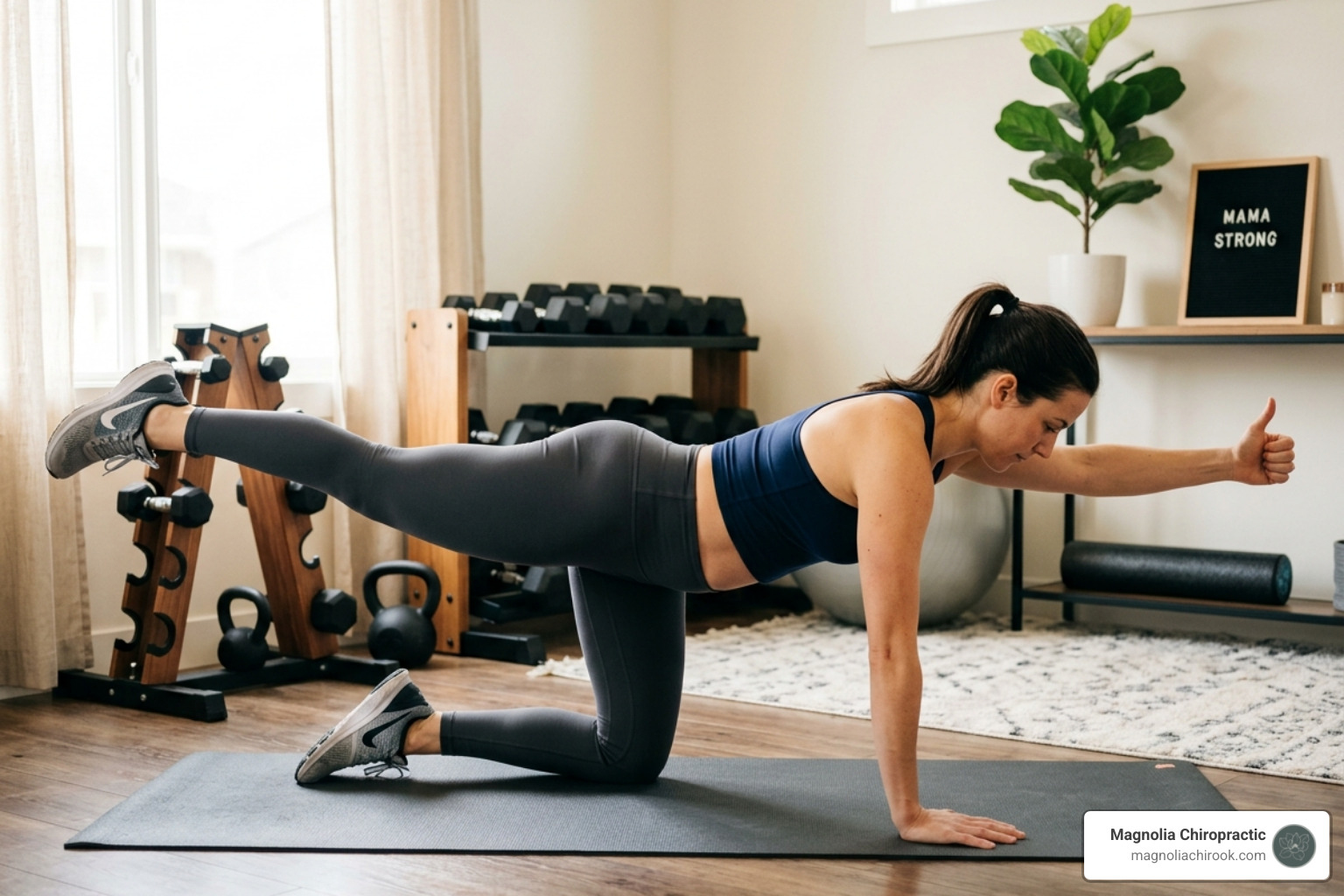
- Bird-Dog: Start on all fours with a flat back. Extend your opposite arm and leg simultaneously while keeping your hips level. This builds core endurance and spinal alignment.
- Glute Bridges: Lie on your back and lift your hips toward the ceiling. This strengthens the "posterior chain" (glutes and lower back), which supports the core canister from behind.
- Modified Dead Bugs: Lie on your back with legs in a "tabletop" position. Lower one foot to tap the floor while keeping your back glued to the mat.
The key here is quality over quantity. If you see coning or feel your back arching, scale back. Your core is a system that requires coordination, not just brute strength.
Step 4: Integrating Pelvic Floor Health into Your Routine
You cannot rebuild your core without addressing the pelvic floor. It is the "hammock" that supports your bladder, uterus, and bowel. Pregnancy and birth can leave these muscles either too weak or, surprisingly, too tight and "guarded."
| Safe Foundational Exercises | High-Pressure Movements to Avoid (Early On) |
|---|---|
| Diaphragmatic Breathing | Traditional Crunches & Sit-ups |
| Pelvic Tilts | Heavy Lifting (without breath support) |
| Glute Bridges | Double Leg Lowers |
| Bird-Dogs | High-Impact Running (before 12 weeks) |
Integrating pelvic floor health means coordinating your breath with your movement. Never hold your breath while lifting your baby or a heavy grocery bag; this creates "downward pressure" that can lead to urinary incontinence or pelvic organ prolapse. Instead, exhale on the exertion (the "lift"). Scientific research on pelvic floor recovery shows that this coordination is often more effective than doing hundreds of isolated Kegels.
Steps 5-7: Nutrition, Rest, and Professional Support for Rebuilding Core Strength Safely After Pregnancy
Rebuilding your core is a biological process, not just a physical one. Your tissues need the right "building blocks" to heal the linea alba and pelvic ligaments.
- Step 5: Nutrition: Prioritize protein-rich foods (eggs, lentils, lean meats) and collagen-supporting nutrients like Vitamin C. Hydration is also essential, especially if you are breastfeeding, to keep connective tissues supple.
- Step 6: Rest and Hormonal Awareness: The hormone relaxin can stay in your system for months after birth (and even longer if breastfeeding), making your joints more "bendy" and prone to injury. Respecting your need for sleep and stress management isn't a luxury; it's a physiological requirement for muscle repair.
- Step 7: Professional Support: Sometimes, despite our best efforts, the "connection" just isn't happening. If you experience leaking, pelvic heaviness, or persistent back pain, it’s time to see a specialist. Chiropractic care for postpartum recovery focuses on realigning the pelvis and spine so your nervous system can communicate clearly with your core muscles.
Conclusion: Building a Strong Foundation for Your Family
Rebuilding your core after pregnancy is a journey of patience and reconnection. It isn't about "bouncing back" to a pre-baby body; it's about building a stronger, more functional version of yourself that can handle the beautiful, physical demands of motherhood. From the first diaphragmatic breath to the day you can run across the park with your toddler, every step matters.
At Magnolia Chiropractic in Norman, OK, we believe in a patient-centered, gentle approach. We don't do one-size-fits-all. We take the time to explain the "why" behind your care, ensuring your recovery supports not just your fitness goals, but your overall family wellness. Whether you are navigating the fourth trimester or are years into your postpartum journey, we are here to help you reach your developmental milestones as a mother.
If you’re ready to start your recovery journey with a team that values evidence-based, tailored care in a supportive setting, we invite you to schedule a consultation at Magnolia Chiropractic. Let’s build your foundation together.
