
Why Holiday Stress Can Feel Different in Your Body
Holiday burnout for moms can show up as tight shoulders, headaches, broken sleep, stomach upset, and fatigue that does not ease after a night of rest. You may also feel irritable or unable to enjoy things you usually like. These signs do not prove you have burnout, but they are worth noticing. Start by protecting sleep, dropping one nonessential task, and asking someone else to take full responsibility for another.
| Regular exhaustion | Possible burnout |
|---|---|
| Often improves with rest | Persists despite rest and may come with detachment or a loss of joy |
The holidays can add gift planning, family schedules, and other work that no one else sees. If symptoms persist or disrupt daily life, talk with a healthcare professional rather than assuming stress is the only cause.
I'm Leah Bagg, a chiropractor in Norman, Oklahoma, with patient-centered training and experience caring for women and families. In The Holiday Mom Burnout: How Stress Shows Up in Your Body, I'll walk through the signs to watch for and practical ways to reduce the load.
Introduction to the Seasonal Strain: Why Maternal Exhaustion Peaks in Winter
Every December, a familiar shift happens in homes across the country. Between organizing school pageants, orchestrating family gatherings, managing travel logistics, and wrapping presents, the seasonal to-do list seems to grow endlessly. What should be a joyful season often turns into an overwhelming marathon of physical and emotional demands.
Maternal exhaustion during this time is not an isolated feeling. Recent research indicates that parental fatigue reaches historic highs during the late fall and winter months. In nationwide studies, 93% of mothers report having experienced burnout, with 58% feeling it often or almost constantly. Furthermore, 71% of mothers report high burnout levels compared to 45% of fathers, and 50% carry chronic guilt about their work-life balance. In Western countries, an estimated 5% to 9% of parents meet the clinical criteria for parental burnout.
Understanding the distinction between regular seasonal fatigue and true burnout is the first step toward reclaiming your health.
| Aspect | Regular Seasonal Exhaustion | Clinical Parental Burnout |
|---|---|---|
| Recovery | Resolves after a good night's sleep or a quiet weekend | Persists regardless of how many hours you sleep |
| Emotional State | Temporarily tired, but still feels connected and engaged | Emotional detachment, numbness, or loss of fulfillment |
| Physical Symptoms | Mild, temporary muscle tiredness | Chronic tension, headaches, digestive disruption, low immunity |
| Triggers | Specific, heavy tasks (like hosting a large dinner) | Everyday routine parenting tasks feel overwhelming |
When seasonal pressure builds without relief, our bodies shift from temporary acute stress into sustained physiological overdrive.
The Holiday Mom Burnout: How Stress Shows Up in Your Body
When stress becomes a constant companion, your body does not view holiday planning as a joyful exercise. Instead, it interprets the relentless calendar management, financial budgeting, and social friction as ongoing biological threats. Recognizing the risks of mom burnout helps us understand that physical exhaustion is not a personal failure, but a physiological reaction. For many mothers, holiday burnout for moms and how stress shows up in your body becomes a pattern of tension, fatigue, and emotional detachment that deserves the same attention as any other health concern.

Somatic Warning Signs: The Holiday Mom Burnout and How Stress Shows Up in Your Body Daily
Stress is somatic—it lives in our tissues, joints, and organs. An estimated 75% to 90% of all primary doctor visits are related to stress-induced conditions. When chronic overload takes over, your body sounds subtle alarms long before an emotional breakdown occurs.
Key physical warning signs include:
- Tension Headaches and Jaw Clenching: Chronic stress leads to sustained contraction of the suboccipital muscles and upper trapezius. Learning how headaches, stress, and tension connect can help you spot tension patterns before a full headache develops.
- Sleep Fragmentation: You may fall into bed exhausted, only to wake at 3:00 AM with a racing mind, unable to fall back asleep.
- Gastrointestinal Distress: The gut and brain communicate constantly via the vagus nerve. Stress slows digestion, leading to bloating, cramping, and appetite changes.
- Immune Suppression: Cortisol dysregulation lowers your body's frontline defenses, making you catch every seasonal cold or flu that enters the household.
- Musculoskeletal Aches: Prolonged physical strain—whether from shopping, carrying toddlers, or hunching over wrapping paper—creates localized joint restrictions. Recognizing these burnout signs you shouldn't ignore allows you to seek care before minor discomfort turns into chronic pain.
The Invisible Mental Load, Cortisol Spikes, and Hormonal Imbalance
Beyond physical chores lies the "invisible labor"—the mental tracking of dietary restrictions, family dynamics, teacher gifts, and holiday traditions. This cognitive weight keeps the hypothalamic-pituitary-adrenal (HPA) axis continuously activated.
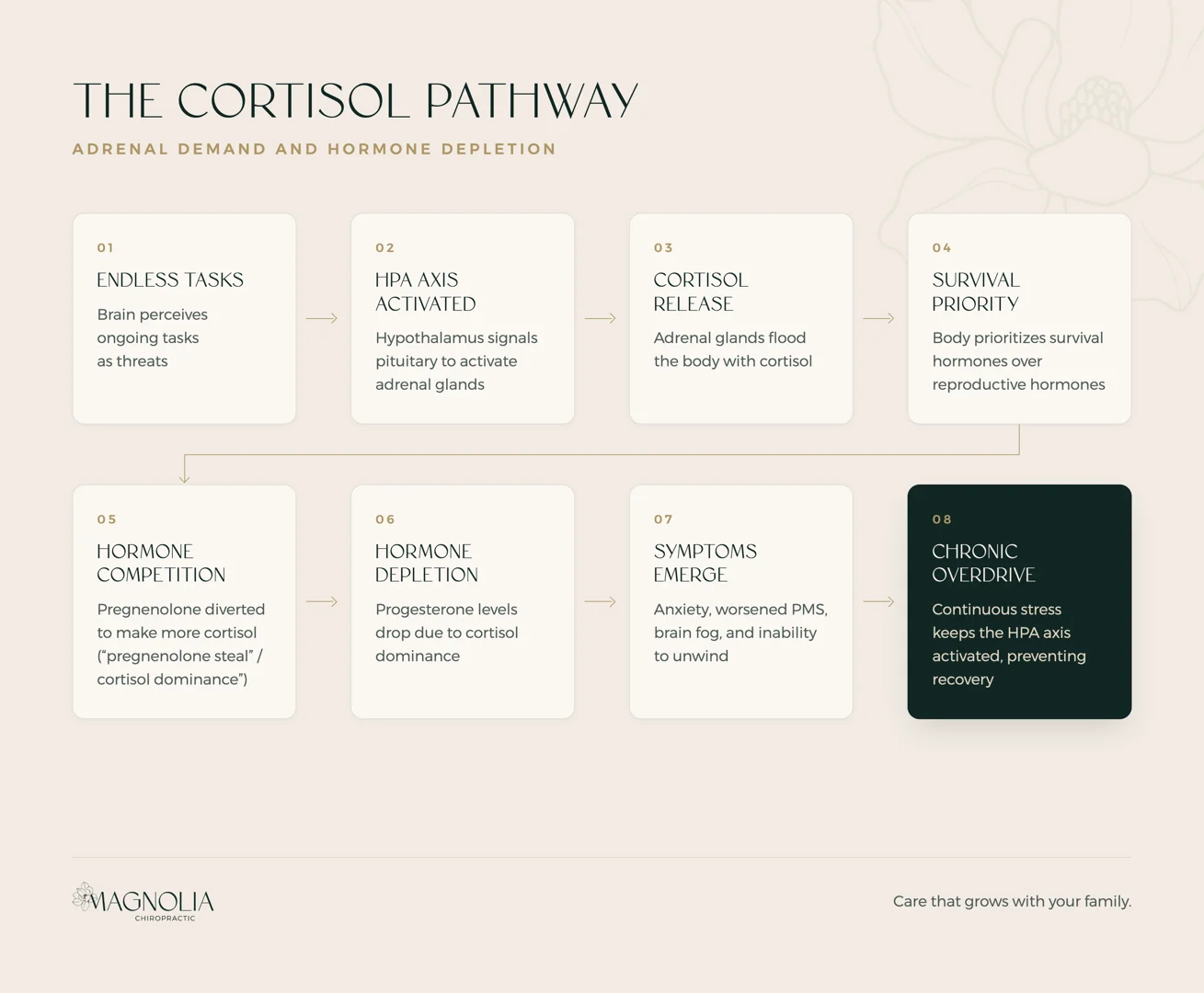
When the brain perceives endless tasks, it signals the adrenal glands to flood the body with cortisol. In sustainable situations, cortisol returns to a baseline level. However, continuous holiday stress creates a biochemical competition often described as the "pregnenolone steal" or cortisol dominance. Because the body prioritizes survival hormones over reproductive hormones, progesterone levels can drop. This imbalance frequently leads to heightened anxiety, worsened PMS, brain fog, and an inability to unwind even in quiet environments. Resources covering stress and hormonal imbalance highlight how unmanaged mental loads translate directly into endocrine dysfunction.
Nervous System Dysregulation and Why Holiday Burnout for Moms Shows Up in Your Body as Pain
The autonomic nervous system is divided into two primary branches: the sympathetic state ("fight-or-flight") and the parasympathetic state ("rest-and-digest"). When holiday demands overwhelm your coping mechanisms, your system gets locked in sympathetic dominance.
In this state, blood flow is diverted away from digestive organs and deep spinal stabilizing muscles toward large limb muscles. Your body prepares to flee a physical threat, creating persistent muscular guarding around the neck, shoulders, and lower back. Observing common signs your nervous system is out of balance helps explain why small stressors suddenly cause intense physical soreness.
For mothers who have given birth in recent years, these stressors can also compound structural vulnerabilities. Reviewing chiropractic care for postpartum recovery reveals how prior core or pelvic adjustments can become aggravated when holiday stress strains posture and movement patterns.
Practical Strategies to Reset Your Nervous System and Restore Balance
Recovering from holiday burnout does not require a week-long solo retreat. Meaningful autonomic recovery happens through consistent, micro-restorative habits that signal safety to your brain.
Restoring Autonomic Regulation Through Boundary Setting and Somatic Rest
When your body is stuck in high gear, intentional boundaries act as biological shields. Shifting into a restful state requires lowering incoming stimulation and gently stimulating the vagus nerve.
Try these simple micro-resets throughout your week:
- The 3-Minute Sensory Grounding: Step into a quiet room or outside. Note 3 things you can see, 2 things you can feel, and 1 thing you can hear to bring your prefrontal cortex back online.
- Diaphragmatic Breathing: Inhale through your nose for 4 seconds, allowing your belly to expand, and exhale slowly for 6 seconds. Longer exhalations lower heart rate and reduce sympathetic tone.
- Implement Micro-Boundaries: Give yourself permission to say, "Let me check our family calendar and get back to you," rather than agreeing immediately to social invitations.
- Protect a 15-Minute Daily Wind-Down: Avoid screens 30 minutes before bed; read, stretch, or sip warm tea to signal circadian rest.
- Simplify Traditions: Pick three core traditions that bring genuine joy to your immediate family, and release the rest without guilt.
Clinical Support and Gentle Family Care for Sustainable Recovery
Sometimes, mindful breathing and boundary setting need hands-on structural support. When physical joint restrictions and spinal tension lock the body into a stress posture, gentle chiropractic adjustments help restore balance to the nervous system.
At Magnolia Chiropractic, we provide patient-centered, gentle chiropractic care tailored specifically for prenatal, pediatric, and family needs. Unlike rushed settings, we take the time to explain how spinal alignment and nervous system function support overall family health. In our pediatric care, we evaluate how gentle support helps infants and toddlers meet foundational developmental milestones like rolling, crawling, and walking with ease, fostering resilient movement from the start.
Investing in family chiropractic care offers a supportive space for both mothers and children to release built-up tension and function at their best.
If you are navigating seasonal exhaustion and want to support your physical resilience, our team at Magnolia Chiropractic is here to help. Discover how our compassionate family chiropractor in Norman, OK can support your family's health this holiday season.
