
Baby Head Preference: What Causes It and When Is Helmet Therapy Needed?

Baby head preference is typically caused by intrauterine positioning, birth strain, or neck tightness such as torticollis. Helmet therapy is generally considered when moderate-to-severe asymmetry does not resolve after conservative repositioning and gentle bodywork by 4 to 6 months of age.
An infant’s skull is remarkably adaptable. During the first year of life, a baby’s brain triples in weight, and three-fourths of all brain growth occurs by age two. To accommodate this rapid expansion, an infant's skull consists of several soft, pliable bone plates connected by flexible fibrous joints called sutures.
While this natural pliability allows a baby to pass safely through the birth canal, it also means the skull is easily molded by outside forces. If an infant routinely rests their head in the exact same orientation, sustained external pressure can cause the soft cranial bones to flatten. Up to 50% of babies develop some degree of positional flattening, which is usually mild and easily addressed when caught early.
Understanding what drives this side preference helps parents make informed, gentle choices for their little one's comfort and healthy development.
Identifying Root Causes: Baby Head Preference: What Causes It and When Is Helmet Therapy Needed?
A consistent head-turning preference rarely happens without a physical reason. Most often, it stems from structural tension or restricted neck mobility that makes resting to one side far more comfortable than the other.
Several common factors can create or reinforce this preference:
- Intrauterine Positioning: During the third trimester, cramped space in the womb—common with multiples, larger babies, or lower amniotic fluid—can keep an infant's head resting in a single position for weeks before birth.
- Birth Mechanics and Interventions: The journey through the birth canal involves significant rotational and compressive forces. Assisted deliveries involving forceps or vacuum extraction, or prolonged labor, can leave babies with birth strain and physical tension throughout the neck, shoulders, and cranial base. If an uneven shape is present at delivery, it often begins to relax and improve within about six weeks as birth compression resolves.
- Congenital Muscular Torticollis: Present in roughly 20% of infants with positional head flattening, torticollis involves tightness or shortening in the sternocleidomastoid muscle on one side of the neck. This makes turning toward the opposite shoulder difficult or uncomfortable.
- Extended Time in Restrictive Gear: While infant car seats, swings, and bouncers are helpful tools, prolonged periods in these semi-upright devices place static pressure on the back of a baby's soft skull.
As outlined in the Mayo Clinic guide on baby head shape causes, identifying the mechanical factors behind a preference allows parents and healthcare providers to address underlying tension before noticeable flattening progresses.
Distinguishing Plagiocephaly, Brachycephaly, and Craniosynostosis
Not all changes in head shape stem from the same root cause. Distinguishing benign positional flattening from conditions requiring surgical intervention is a critical clinical step.
| Condition | Primary Cause | Visual Presentation | Suture Status | Standard Treatment |
|---|---|---|---|---|
| Positional Plagiocephaly | External pressure & neck preference | Asymmetrical flattening on one side; parallelogram head shape from above; ear on flat side pushed forward | Sutures open (patent) | Repositioning, bodywork, tummy time; helmet therapy if moderate/severe |
| Positional Brachycephaly | Sustained pressure flat on back of head | Uniform, central flattening across the back of the head; skull appears abnormally wide and tall | Sutures open (patent) | Repositioning, upright carrying; helmet therapy if moderate/severe |
| Craniosynostosis | Genetic / developmental anomaly | Rigid, boat-shaped, triangular, or severely asymmetrical skull; raised bony ridges along suture lines | Premature suture fusion | Craniofacial pediatric surgery; post-operative helmet therapy |
According to the NCBI StatPearls clinical overview of plagiocephaly, positional plagiocephaly and brachycephaly do not involve fused bones and do not restrict brain growth (NBK564334). In contrast, craniosynostosis involves the premature fusion of one or more cranial sutures, which requires specialized pediatric craniofacial management.
Clinical Evaluation: Baby Head Preference: What Causes It and When Is Helmet Therapy Needed?
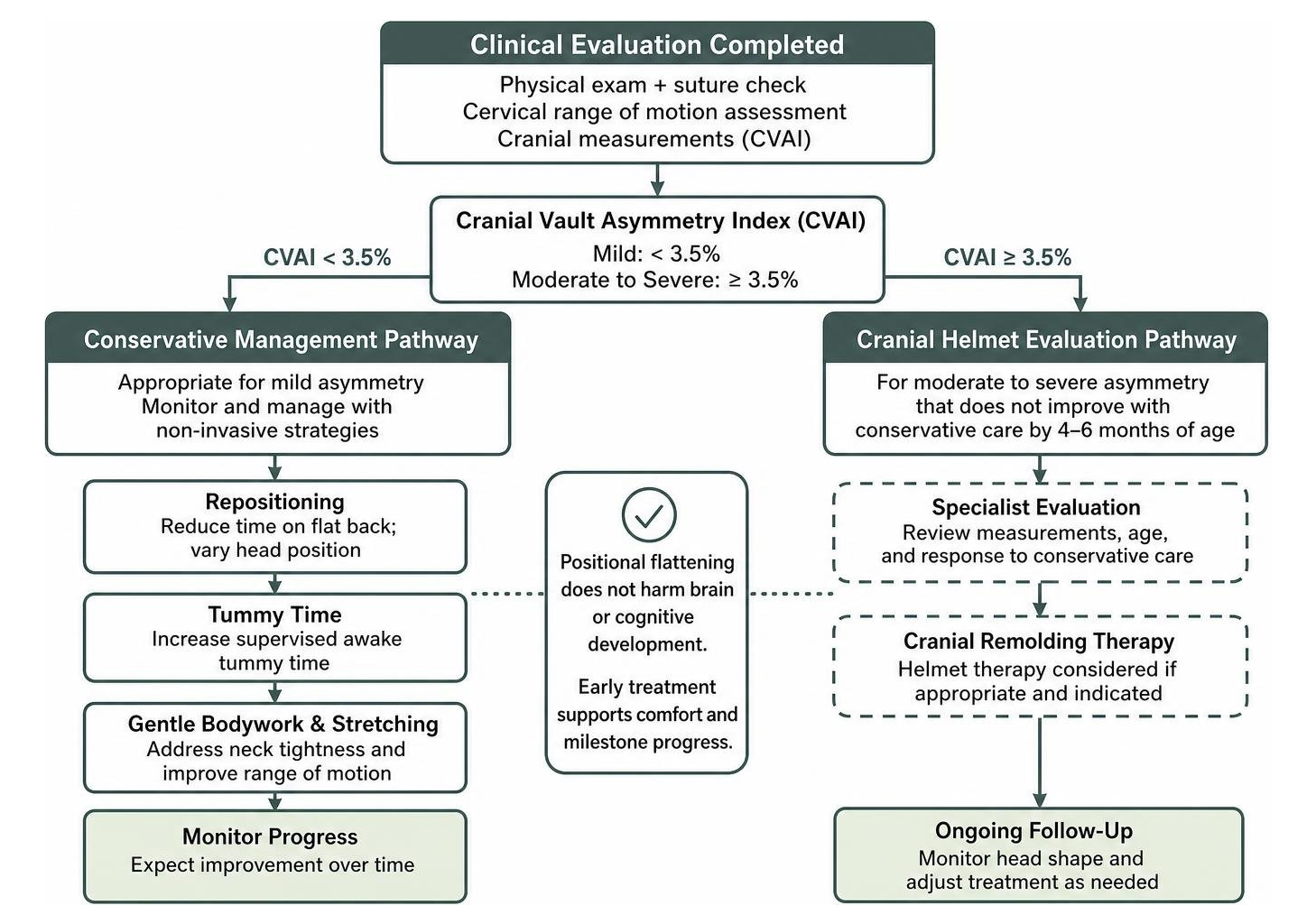
A thorough clinical assessment by your pediatrician or a pediatric specialist begins with a hands-on physical exam. The provider will gently palpate your baby’s skull to feel the fontanelles (soft spots) and confirm that all suture lines remain open and flexible. They will also assess full cervical range of motion to see whether tight neck muscles are limiting movement.

To objectively evaluate the degree of asymmetry, specialists often use anthropometric calipers or a non-invasive 3D surface scan. These tools measure specific cranial dimensions to calculate the Cranial Vault Asymmetry Index (CVAI):
- Mild Asymmetry (CVAI < 3.5%): Typically monitored and managed with conservative at-home repositioning and bodywork.
- Moderate to Severe Asymmetry (CVAI ≥ 3.5%): Often evaluated for targeted physical therapy and potential cranial remolding therapy if conservative steps have not created balance by 4 to 6 months of age.
Parents can rest assured that benign positional flattening does not harm your baby’s intellect, neurological health, or cognitive development. However, balancing structural tension early on through gentle infant bodywork support ensures that your baby moves comfortably, which supports essential physical milestones such as rolling, sitting up, and crawling.
Conservative Treatment Strategies and Long-Term Outlook
When addressed early—especially before four months of age—most cases of infant head preference and mild-to-moderate flattening improve significantly through non-invasive, conservative care.
Repositioning, Tummy Time, and Gentle Bodywork
The first line of support focuses on taking direct pressure off the flat area while restoring full, comfortable neck movement.
- Active Counter-Positioning: When your baby is resting in the crib on their back, gently turn their head toward their non-preferred side. You can encourage this naturally by rotating the direction your baby sleeps in the crib each night, prompting them to turn toward the door or a dim nightlight.
- Supervised Tummy Time: Aim for several short sessions of supervised tummy time across the day while your baby is awake. Tummy time takes all pressure off the occiput while strengthening the neck, shoulder, and core muscles needed for rolling and crawling. If your baby fusses on the floor, try tummy time chest-to-chest with you while you recline.
- Alternating Feeding and Holding Angles: Switch feeding arms regularly whether breastfeeding or bottle-feeding. Practice upright cuddling and ergonomic babywearing methods to support spinal alignment while reducing static pressure against the back of the skull.
- Gentle Pediatric Bodywork: Gentle, pediatric-specific chiropractic care uses feather-light pressure to release soft-tissue tension in the neck, spine, and cranial base. Restoring full cervical mobility allows your baby to explore their surroundings evenly, making tummy time more enjoyable and natural head turning effortless.
Timeline, Wear Requirements, and Practical Considerations for Helmeting
If conservative repositioning and physical or chiropractic therapy do not resolve moderate-to-severe asymmetry by 4 to 8 months of age, your pediatrician may refer you to a certified orthotist for a cranial remolding orthosis (helmet).
Molding helmets do not squeeze or forcefully shape your baby’s head. Instead, a custom-fitted helmet provides a hard outer shell with soft interior relief zones. It acts as a gentle pathway: the helmet rests lightly against prominent areas while leaving open space over flattened areas, directing rapid brain and skull growth into a symmetrical contour.
Here is what parents should expect during helmet therapy:
- Optimal Window: Helmets work best between 3 and 6 months of age, when the skull is growing fastest and cranial bones are soft. While effective up to 12 to 18 months, treatment takes longer as skull growth slows.
- Wear Schedule: A helmet is typically worn for 23 hours per day, removed only for bathing and brief skin checks.
- Duration: Most treatment courses last between 3 and 6 months (often around 12 weeks when started early).
- Monitoring and Care: Frequent visits (every 1 to 3 weeks) are necessary to adjust the inner foam as your baby grows. Parents should clean the helmet daily with rubbing alcohol and monitor the scalp for minor red spots or irritation.
- Cost and Insurance: Costs vary based on device specifications and orthotic adjustments; insurance coverage depends on measured severity metrics (such as CVAI scores).
As detailed in the Cleveland Clinic overview of infant helmet therapy, consistent compliance combined with active movement produces the most predictable outcomes.
At Magnolia Chiropractic, we understand that noticing a flat spot or head tilt can feel overwhelming. We take a gentle, whole-body approach to infant care, assessing neck mobility, cranial tension, and movement patterns to help your little one thrive. Whether you are navigating early repositioning or seeking supportive care during helmet therapy, our team provides patient-centered, unhurried support for families across the OKC metro. If you would like guidance tailored to your baby's needs, connect with a specialized pediatric chiropractor in Norman, OK today to schedule a gentle evaluation.
