
10 Signs Your Baby May Have Tension After Birth
Why So Many Newborns Experience Tension — And What Parents Can Do

Signs your baby may have tension after birth (and what to do about it) is something more parents are asking about — and for good reason. Here's a quick overview:
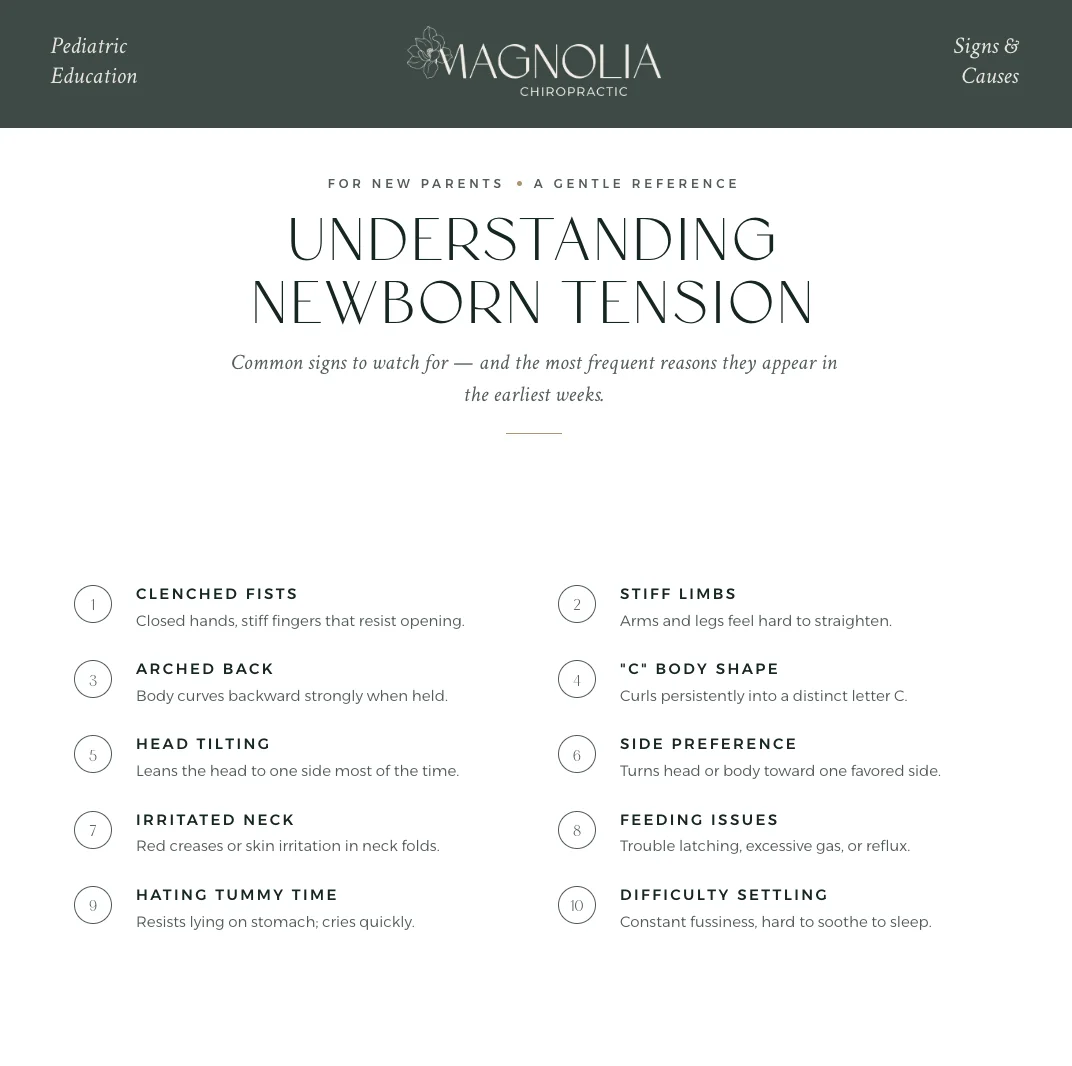
Common signs of tension in newborns:
- Clenched fists or stiff, hard-to-straighten limbs
- Arching the back or curving the body into a C-shape
- Head tilting or turning preference to one side
- Red, irritated neck creases
- Trouble latching, feeding, or excessive gas/reflux
- Hating tummy time or the car seat
- Fussiness and difficulty settling
What to do: Tension in the first 1–2 weeks after birth is considered normal. If it persists beyond that, gentle at-home techniques (like infant massage and floor time) and a professional evaluation — from a pediatric chiropractor, osteopath, or physical therapist — can help.
Your baby spent months curled up in a tight, warm space. Then came birth — one of the most physically demanding transitions a tiny body will ever go through. It makes sense that many newborns carry some of that physical stress with them into the world.
Most of the time, a little tension in the early weeks is perfectly normal. But when it lingers, it can quietly affect how your baby feeds, sleeps, moves, and grows.
I'm Dr. Leah Bagg, a chiropractor with specialized training in infant and pediatric soft tissue techniques, and I work with families every day who are navigating signs your baby may have tension after birth (and what to do about it) — from feeding struggles to body asymmetry and beyond. I'll walk you through what to look for and how to support your baby gently and confidently.
Recognizing the Signs Your Baby May Have Tension After Birth (And What to Do About It)
As we move into April 2026, our understanding of infant wellness continues to evolve, moving toward a more holistic view of how a baby’s physical body interacts with their nervous system. When we talk about "tension," we aren't just talking about tight muscles. We are talking about how a baby’s body has adapted to the cramped quarters of the womb and the intense journey of birth.

In the clinical world, severe muscle stiffness is sometimes referred to as hypertonia. While true clinical hypertonia is less common than its opposite (hypotonia, or "floppy baby" syndrome), many infants experience a functional version of tension. This is often the result of "birth trauma"—a term that sounds scary but simply refers to the physical pressures exerted on a baby during delivery.
Whether it was a very fast labor, a prolonged pushing stage, or an assisted delivery involving a vacuum or forceps, these experiences can leave a baby’s nervous system in a state of "high alert." Even a C-section, while often necessary and life-saving, lacks the natural "squeezing" process of the vaginal canal that helps a baby’s body begin to decompress and transition. Sometimes, the baby’s position in the birth canal, such as asynclitic (tilted) positioning, can compress the delicate nerves at the base of the skull, leading to the signs your baby may have tension after birth (and what to do about it) that we see in our Norman, OK office.
Physical Clues and Signs Your Baby May Have Tension After Birth (And What to Do About It)
Parents are often the first to notice that something feels "tight." You might notice your baby always keeps their hands in tightly clenched fists, even when they are sleeping or calm. While newborns do have a natural grasp reflex, persistent fisting—especially with the thumb tucked deep under the fingers—can be a sign of fascial or muscular strain.
Other common signs of tension in infants include:
- The "Banana" Posture: When lying on their back, the baby’s body naturally curves into a C-shape or "banana" shape, always pulling toward one side.
- Head Tilt (Torticollis): The baby consistently tilts their ear toward one shoulder or has a strong preference for looking in only one direction.
- Arching Back: Frequent arching of the back and neck, especially when being held or during feedings, as if they are trying to move away from a source of discomfort.
- Red Neck Creases: If you notice deep, red, or irritated creases in the folds of the neck, it may be because the baby is constantly shrugging their shoulders up toward their ears or "scrunching" their neck due to tension.
- Stiff Limbs: Feeling resistance when you try to gently dress the baby or straighten their arms and legs.
Feeding and Digestive Challenges
Tension doesn’t stay on the outside; it affects internal functions too. For a baby to feed successfully, they need to coordinate a complex "suck-swallow-breathe" rhythm. This requires incredible mobility in the jaw, tongue, and neck.
When a baby has birth-related tension, particularly around the jugular foramen (where vital cranial nerves exit the skull), it can impair this rhythm. This is why we often see a crossover between body tension and tongue ties feeding challenges and chiropractic support. If the jaw is tight or the neck is restricted, the baby cannot open their mouth wide enough for a deep, comfortable latch.
This tension can lead to:
- Reflux and Gas: A poor latch causes the baby to swallow excess air, leading to a bloated tummy and painful gas.
- Colic Symptoms: That "unexplained" crying that lasts for hours is often a baby’s only way of saying their body feels uncomfortable. Many parents find relief after visiting a chiropractor for babies with colic, as gentle adjustments help settle the nervous system.
Behavioral Indicators and Signs Your Baby May Have Tension After Birth (And What to Do About It)
Sometimes tension shows up in how a baby reacts to their environment. Does your baby scream the moment they are buckled into a car seat? Does they seem to "hate" tummy time, even more than the average newborn? These aren't necessarily personality traits; they are often indicators that those specific positions are physically uncomfortable due to existing tightness.
Another confusing sign is the "strong" baby. We often hear parents say, "My baby is so strong! They could hold their head up from day one!" While it’s wonderful to have a sturdy little one, early milestones: strong baby or signs of tension? is a question worth asking. If a newborn is lifting their head high off the chest in the first few days, it may actually be due to overactive neck extensors (tightness) rather than true muscular strength.
| Movement Category | Normal Newborn Movement | Tension-Based Movement |
|---|---|---|
| Head Control | Floppy but slowly gaining stability | Rigid, lifting head unusually early |
| Body Shape | Relaxed, symmetrical "frogged" legs | C-shaped curve or "banana" posture |
| Hands | Open and close naturally | Persistently clenched fists |
| Tummy Time | Tolerates short bursts with gradual lift | Intense crying, arching, or "log rolling" |
| Feeding | Rhythmic suck/swallow, relaxed body | Pulling off, arching, clicking sounds |
Supporting Your Baby’s Comfort and Development
At Magnolia Chiropractic, we believe that a relaxed baby is a thriving baby. When we address signs your baby may have tension after birth (and what to do about it), we aren't just looking for a "quick fix" for crying. We are looking to support the baby's long-term wellness, sensory processing, and midline organization.

Midline organization is the baby’s ability to bring their hands to their mouth, tuck their chin, and find a sense of "center." When tension pulls them into an arched or tilted position, they lose that center, which can later impact milestones like rolling, crawling, and sitting up symmetrically.
Gentle At-Home Techniques for Relief
While professional care is important, there is so much you can do in the comfort of your own home to help your baby "unwind."
- Container-Free Time: Limit the time your baby spends in "containers" like swings, bouncers, or car seats. These devices often hold the baby in a semi-flexed position that can exacerbate tension. Aim for lots of floor play on a firm, flat surface where they can stretch freely.
- Infant Massage: Gentle, rhythmic strokes on the legs, arms, and back can help signal the nervous system to relax. Focus on the "I Love You" stroke for digestion and gentle circular motions around the jaw.
- Modified Tummy Time: If your baby hates the floor, try tummy time on your chest (skin-to-skin) or draped over a nursing pillow. This makes the position feel safer and less physically demanding.
- The "Guppy" Position: Gently laying the baby across your lap or a pillow so their head hangs back slightly (with full support) can help stretch the tight muscles at the front of the neck and chest.
For more detailed ideas, you can explore why is my baby so tense: understanding causes and soothing techniques to build a toolkit of comfort for your little one.
The Role of Pediatric Chiropractic Care
You might be wondering, "What exactly does a chiropractor do for a baby?" It is vastly different from adult chiropractic. There is no "cracking" or "popping." At Magnolia Chiropractic, our pediatric adjustments involve no more pressure than you would use to check the ripeness of a tomato.
We use a gentle, functional movement assessment for infants to look at how your baby moves, rests, feeds, and responds to touch and positioning. This helps us identify areas where the body may be holding tension after birth. From there, we can provide very specific, gentle adjustments aimed at supporting more comfortable movement, better regulation, and easier "rest and digest" function.
Understanding what is pediatric chiropractic is the first step for many parents in realizing how safe and supportive this care can be. Our pediatric chiropractic benefits complete guide explains how this care supports everything from immune function to better sleep.
When to Seek Professional Guidance
It is never too early to have your baby checked for tension. In fact, many parents in the Norman and OKC metro area bring their newborns in within the first week of life to ensure they are starting off on the right foot.
You should consider seeking professional guidance if you notice:
- Your baby can only turn their head to one side.
- Feeding remains painful or difficult despite help from a lactation consultant.
- The "banana" curve persists beyond the first month.
- Your baby seems "stuck" in a state of fussiness or fight-or-flight.
Our goal is to ensure that as your baby grows, they move symmetrically. Symmetrical movement is the foundation for healthy crawling and walking. When a baby has balanced tension, they don't just feel better—they are better equipped to hit their developmental milestones with ease.
If you’re ready to see how a tailored, evidence-based approach can help your family, we invite you to learn more info about pediatric chiropractic services at our Norman, OK office. We are here to provide the thorough explanations and gentle care your baby deserves, helping them transition from the womb to the world as comfortably as possible.
