
Tongue Ties, Feeding Challenges, and Chiropractic Support: What Parents Should Know
When Feeding Feels Hard: What Parents Should Know About Tongue Ties and Chiropractic Support

Tongue ties, feeding challenges, and chiropractic support are three topics that are deeply connected — and understanding how they relate can make a real difference for struggling families.
If your baby is having trouble feeding, here is a quick summary:
- Tongue tie (ankyloglossia) is a condition where the tissue under the tongue is too short or tight, limiting how well the tongue can move
- It affects roughly 1 in 10 babies, though only about half of those experience significant feeding difficulties
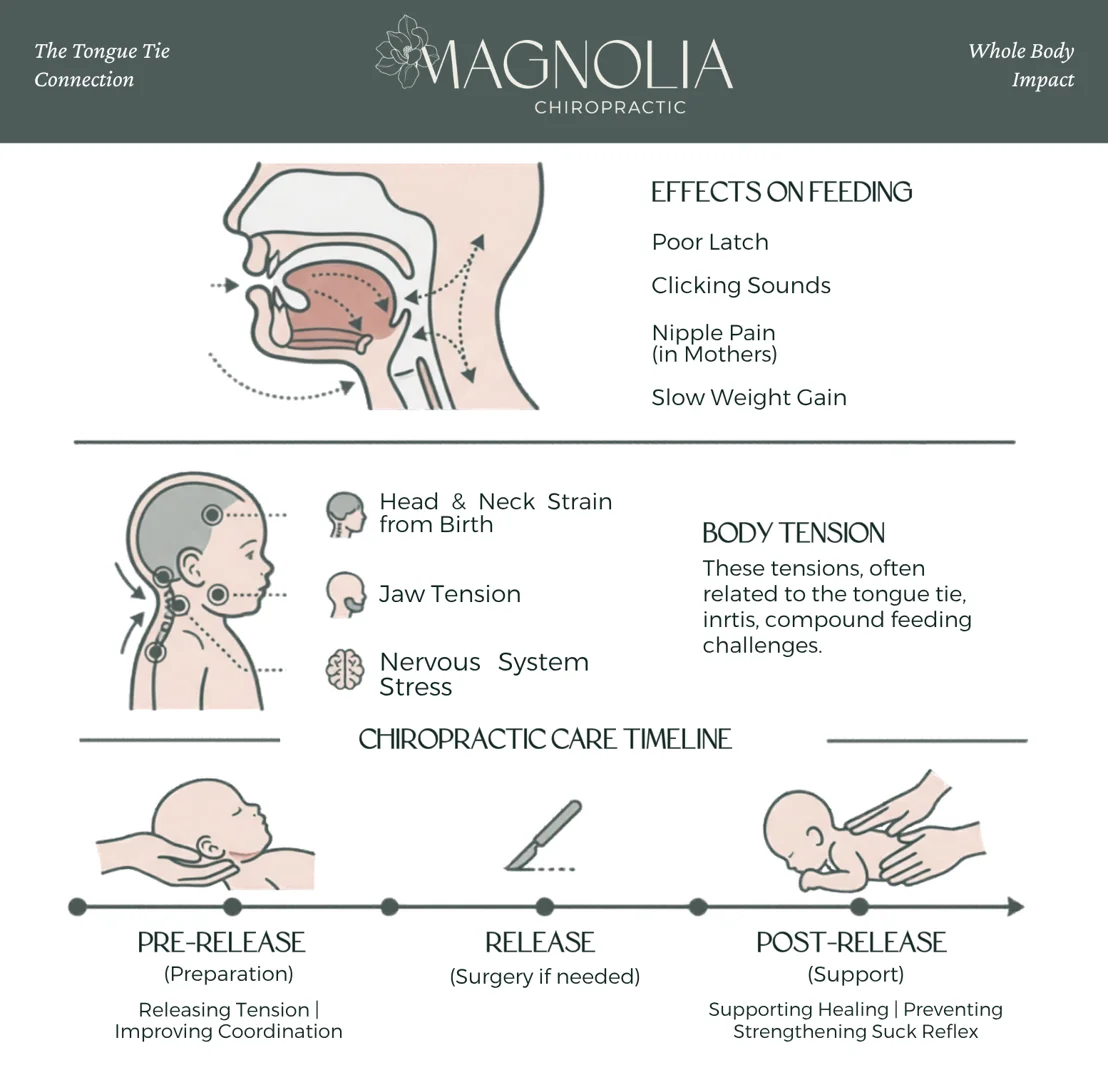
- Common signs include a poor latch, clicking sounds during feeding, slow weight gain, and nipple pain in nursing mothers
- Chiropractic care can help by releasing tension in the neck, jaw, and cranial bones, supporting the nervous system, and improving feeding coordination
- It works both before a tongue tie release (to prepare the body) and after (to support healing and prevent reattachment)
- In some cases, chiropractic care may reduce or eliminate the need for a surgical release altogether
Feeding difficulties are stressful. They can leave parents feeling helpless, exhausted, and unsure where to turn. A tongue tie is often the first thing that gets identified — but it is rarely the whole picture.
Many babies also carry tension in their neck, jaw, and upper spine from the birth process itself. That tension can interfere with the suck-swallow-breathe reflex that is essential for feeding, whether at the breast or bottle.
The good news is that there are gentle, evidence-based options that address the whole baby — not just the tongue.
I'm Dr. Leah Bagg, chiropractor at Magnolia Chiropractic in Norman, OK, with specialized training in tongue ties, feeding challenges, and chiropractic support through organizations including the ICPA, Spinning Babies, and Peak Potential Institute. Supporting infants and their families through feeding difficulties is one of the most meaningful parts of my work, and I want to help you feel informed and confident as you navigate this journey.
Understanding Tongue Ties, Feeding Challenges, and Chiropractic Support
To understand how Tongue Ties, Feeding Challenges, and Chiropractic Support fit together, we first have to look at the anatomy. Ankyloglossia, the clinical term for tongue tie, occurs when the lingual frenulum—the small band of tissue connecting the tongue to the floor of the mouth—is unusually short, thick, or tight.
This isn't just a "tongue issue." The tongue is a powerful muscle connected to the hyoid bone in the neck and influenced by the nerves exiting the base of the skull. When this tissue restricts movement, it doesn't just make sticking the tongue out difficult; it prevents the tongue from elevating to the roof of the mouth, which is essential for creating the vacuum seal needed for breastfeeding or bottle feeding.
Research suggests that while about 1 in 10 babies are born with some form of visible membrane under the tongue, only about half of those babies display significantly reduced function. This is a crucial distinction. It means that the presence of a "string" under the tongue doesn't always guarantee a feeding problem, and conversely, a "hidden" restriction can cause major issues.
Anterior vs. Posterior Tongue Ties
Not all ties look the same. They are generally categorized into four types:
- Anterior Ties (Types 1 & 2): These are the classic "heart-shaped" tongues where the tie attaches near the tip. They are easy to see but only tell part of the story.
- Posterior Ties (Types 3 & 4): These are often "hidden" under the mucous membrane. You might not see a string, but you can feel a tight, fibrous "speed bump" at the base of the tongue. These often cause significant feeding difficulties because they restrict the back of the tongue from lifting.
Scientific research, such as the work by Knox (2010), highlights that a frenotomy (the surgical release of the tie) can be highly effective for newborns, but the best outcomes often involve a multidisciplinary approach that addresses the baby’s structural tension.
Identifying Symptoms of Tongue Ties, Feeding Challenges, and Chiropractic Support Needs
As a parent, you are the best observer of your baby’s comfort. If feeding feels like a "battle" rather than a bonding moment, it’s worth investigating. Symptoms often show up in both the baby and the mother.
Signs in the Baby:
- Poor Latch: The baby may slip off the breast or bottle frequently.
- Clicking Sounds: This indicates the vacuum seal is breaking during the swallow.
- Reflux and Gassiness: When a baby can't get a deep seal, they often swallow excess air (aerophagia), leading to "colicky" behavior.
- Poor Weight Gain: The baby may tire out before getting enough milk because they are working twice as hard to feed.
- Mouth Breathing: A tongue that cannot rest on the palate often leads to an open-mouth posture, even during sleep.
Signs in the Mother:
- Nipple Pain or Damage: Creasing, bruising, or "lipstick-shaped" nipples after a feed.
- Blocked Ducts or Mastitis: If the baby isn't effectively draining the breast, milk stasis can occur.
- Low Milk Supply: Supply is driven by demand; if the baby isn't "ordering" enough milk through efficient sucking, supply may drop.
For families in the OKC metro area, we often see these symptoms overlap with other structural issues. You can learn more about how we evaluate these patterns on our pediatric chiropractor Norman OK page.
| Symptom | Anterior Tie | Posterior Tie |
|---|---|---|
| Visibility | Easily seen at the tip | Felt at the base, often hidden |
| Tongue Shape | Heart-shaped or notched | Square or flat |
| Latch Style | Shallow, pinchy | Often looks deep but slips off |
| Swallow | Significant clicking | Gulping or choking |
How Oral Restrictions Create Body-Wide Tension
One of the most overlooked aspects of Tongue Ties is the "domino effect" of tension. The body is connected from head to toe by a web of connective tissue called fascia. When the tongue is tethered, it creates a pull that travels down the front of the neck, into the chest, and even into the diaphragm.
Babies with tongue ties often live in a state of "sympathetic overdrive"—the fight-or-flight part of the nervous system. Because they struggle to eat and breathe simultaneously, their bodies become guarded. You might notice your baby:
- Arching their back during or after feeds.
- Clenching their fists constantly.
- Having a "head-turning preference" (torticollis).
- Being unable to settle into a deep sleep.
This isn't just "fussiness." It is a physical compensation for a restricted airway and mouth. By addressing these fascial patterns, we help the baby move out of a stressed state and into a "rest and digest" state. For more deep dives into these connections, explore our chiropractic resources.
The Role of Birth Trauma in Feeding Difficulties
It is important to ask: Is it just a tongue tie, or is it birth-related tension? The journey through the birth canal (or a surgical birth) involves significant pressure on a baby’s head and neck.
- C-Sections: While life-saving, the quick pressure change and the "pulling" required can cause strain in the upper cervical spine (the neck).
- Forceps or Vacuum Extraction: These interventions apply direct traction to the skull and neck, often leading to subluxations (misalignments) that interfere with the cranial nerves.
Specifically, the Hypoglossal Nerve (which controls tongue movement) and the Glossopharyngeal Nerve (which controls swallowing) exit the skull near the top of the neck. If there is tension in these areas, the "signal" from the brain to the tongue gets fuzzy. This is why some babies look like they have a tongue tie, but their issues actually stem from a "biomechanical" restriction in the neck or jaw.
The Benefits of Chiropractic Care for Tongue-Tied Infants
Our primary goal is nervous system regulation. We aren't "cracking" a baby's back—in fact, pediatric adjustments are as gentle as checking the ripeness of an avocado.
By performing specific, light-touch adjustments to the spine and cranial bones, we help balance the Vagus Nerve. This nerve is the "superhighway" of the parasympathetic nervous system, governing digestion, heart rate, and the coordination of the suck-swallow-breathe reflex.
A pilot study by Ball & Bennett (2021) found that bodywork can significantly improve functional breastfeeding difficulties by reducing musculoskeletal tension. Similarly, a case series in the Journal of Chiropractic Medicine showed that chiropractic management was effective for infants struggling with breastfeeding.

Supporting Your Baby Before and After a Tongue Tie Release
If a frenectomy (release) is necessary, chiropractic care is an essential "pre-hab" and "rehab" tool.
Pre-Release Support: Think of a tongue tie like a tight sail on a boat. If the mast (the neck and jaw) is crooked, cutting the sail won't fix the whole problem. We want to align the "mast" first. By reducing body tension 2–4 sessions before a release, the provider can get a better view of the tissue, and the baby is less likely to "clamp down" during the procedure.
Post-Release Support: After a release, the body has to learn how to use its "new" tongue. This is called neuromuscular re-education.
- Preventing Reattachment: The mouth heals incredibly fast. If the neck and jaw remain tight, the tongue may settle back into its old position, increasing the risk of the wound healing shut (reattachment).
- Improving Coordination: We help the brain and tongue "talk" to each other again, ensuring the baby doesn't just have more movement, but better movement.
Whether you are preparing for a procedure or looking for family chiropractor Norman OK services to support general wellness, integrated care is key.
Gentle Techniques for Tongue Ties & Feeding Challenges
At Magnolia Chiropractic, we use a variety of specialized, low-force techniques tailored specifically for newborns:
- Craniosacral Therapy (CST): A very light touch used to release restrictions in the bones of the skull and the underlying fascia. This is particularly helpful for babies with "flat spots" or those who had a difficult birth.
- Myofascial Release: We gently work with the soft tissues of the floor of the mouth, the jaw (TMJ), and the neck to "unwind" the tension patterns caused by the tie.
- Intraoral Work: With a gloved finger, we may perform gentle stretches inside the baby's mouth to help desensitize a strong gag reflex and encourage proper tongue elevation.
- Spinal Adjustments: These are sustained pressure points (no "popping") that help the nervous system move out of a stressed state.
Many parents ask us, "Is this safe for my newborn?" The answer is a resounding yes. Our techniques are evidence-based and designed for the delicate anatomy of an infant. You can read more on our chiropractor FAQs Norman OK page.
A Collaborative Approach to Long-Term Wellness
We believe that "it takes a village" to support a feeding journey. Chiropractic Support works best when treatments are part of a multidisciplinary team. We aren't here to replace your lactation consultant or your dentist; we are here to make their jobs easier and your baby’s results more lasting.
In our Norman, OK office, we frequently collaborate with:
- International Board Certified Lactation Consultants (IBCLCs): To work on latch mechanics and milk transfer.
- Pediatric Dentists & ENTs: To provide the surgical release when functional improvements aren't enough.
- Speech and Myofunctional Therapists: To support older children who may have developed speech or airway issues due to untreated ties.
Our mission at Magnolia Chiropractic is to provide thoughtful, tailored care that treats your family like our own. We don't believe in rushed, one-size-fits-all appointments. Instead, we take the time to explain the "why" behind every adjustment, ensuring you feel empowered as a parent.
If you are struggling with feeding, noticing body tension, or have been told your baby has a tongue tie, we invite you to reach out. Whether the answer is a few gentle adjustments or a referral to a specialist, we are committed to helping your baby feed, grow, and thrive.
Ready to see how we can support your little one? Book your evaluation with a Pediatric Chiropractor in Norman, OK today.
